The Catacombs of San Callisto, explained
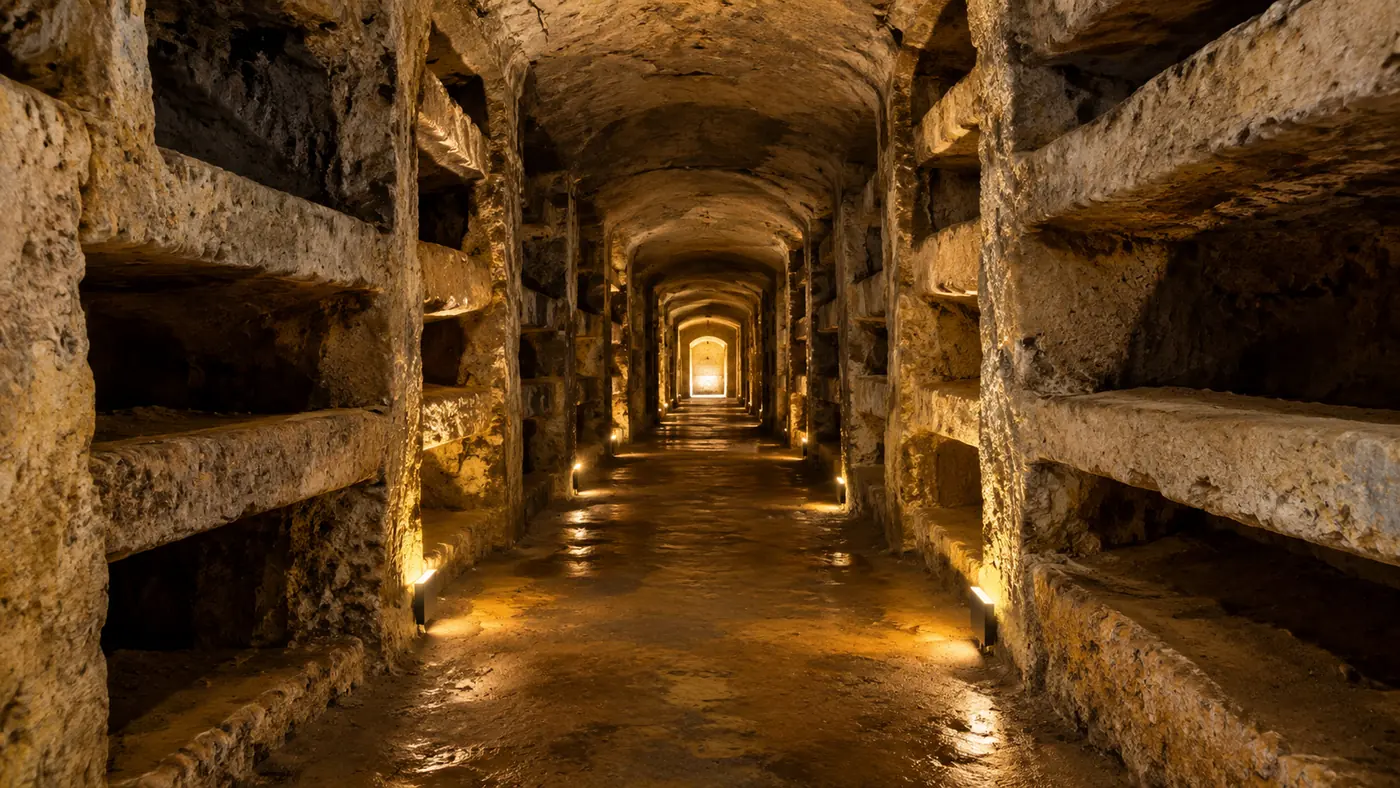
San Callisto can only be visited on a guided tour led by the catacombs’ own staff, and that guiding is already included in the entry ticket. Every visitor gets the same walk, whatever they paid to get there. What the tour operators sell is the journey out to the Via Appia Antica and what surrounds it — which on this particular road is worth more than it sounds.
Six years of walking people down this road, and the first question is always whether there are bones. There are not, and I will come to why. The second thing worth knowing: whatever you pay to get out here, the forty minutes underground is not what you are buying.
Ready to go underground?Every tour here ends up on the same staff-led walk. Pick the one whose journey you want.
Compare the sixNobody sells a better tour of this catacomb
You cannot walk San Callisto by yourself. The custodians’ regulations say so three separate times: all tours are guided by authorised personnel, the minimum group is two, and no one may visit alone, leave their group or pass the gates that mark the public paths. The Salesians of Don Bosco have run reception and guiding here since 1930, and that guiding is already inside the €10 door ticket, in Italian, English, French, Spanish and German.
Which means the package tourist off the coach and the person who paid €14 and caught bus 118 get the same staff member and the same forty minutes. You can watch it in the reviews: a guide called Geoffroy is thanked by name under three different GetYourGuide listings, because he works for the catacombs rather than any of them. A reviewer of a tour I do not sell here put it plainly after paying for a ride out and back: “Could have takes a Uber/taxi and pay at least half price for the same experience.”
The honest baseline, then. Buy the entry ticket, take Metro B to Circo Massimo and bus 118 to the Catacombe di San Callisto stop, two minutes from the gate, and the whole thing costs the ticket plus a standard Rome bus fare. That is a good day out. If you are comfortable on a Roman bus, stop reading the tour listings.
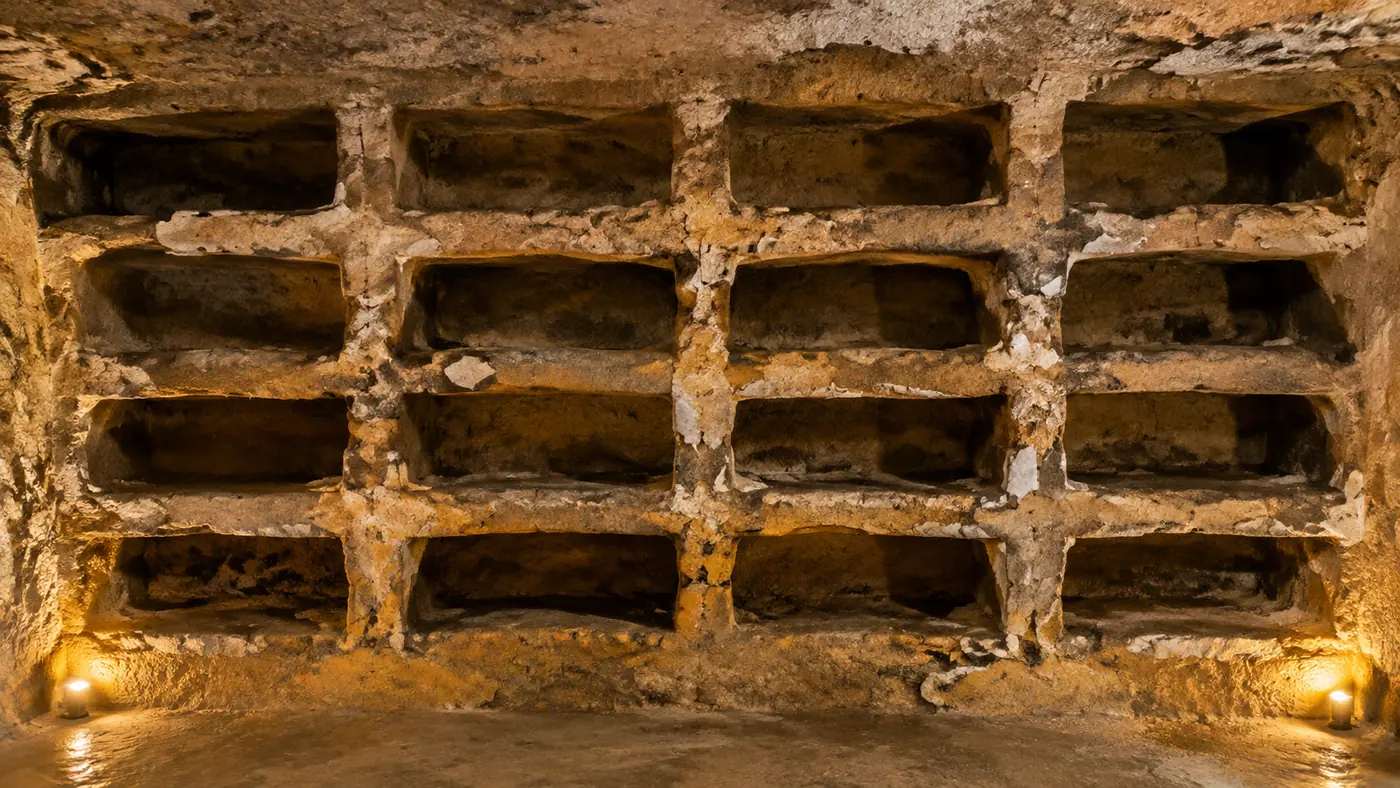
The niches are open, and they are empty
Most people arrive picturing the Capuchin Crypt on Via Vittorio Veneto: a crypt under a Baroque church in the city centre, around 3,700 sets of remains along its corridor, photography allowed, open on Wednesdays when San Callisto is shut. If bones are what you want, go there. That is advice, not a rebuke.
What emptied San Callisto was security. Towards the end of the eighth century and the beginning of the ninth, after the cemeteries outside the walls were sacked, the popes ordered the relics of the martyrs and saints moved into churches inside the city. St Cecilia’s went to Trastevere in 821, and the statue in her crypt is a copy of Maderno’s 1599 original, which one reviewer of the Appian Way tour correctly called a replica. The sealing slabs are largely gone too. You walk between rectangular holes cut in soft volcanic tufo, and the emptiness is the history, not a disappointment.
Why they dug down here in the first place
Not to hide. Roman law forbade burial inside the city walls, land out here was scarce and expensive, and Christians buried rather than cremated, which needs far more room. Digging into tufo was the cheap answer to an arithmetic problem. Candida Moss puts it bluntly: “Christians never hid in the catacombs. The idea that they did is an 18th and 19th century myth for tourists.” Persecution was sporadic rather than continuous, and everyone knew where these cemeteries were, which is rather the point of a cemetery. Before Christians had ground of their own they used the common ones: St Peter went into the public necropolis on the Vatican hill, St Paul into one on the Via Ostiense.
People did come down here, though: for funeral meals, to commemorate the dead, and later as pilgrims in numbers, roughly between 400 and 800. Gathering is not hiding.
What is actually in the Crypt of the Popes
The custodians call it the little Vatican. Nine popes are buried in the crypt itself and sixteen in the complex, two numbers that get muddled constantly. The original Greek inscriptions of five popes survive on the walls: Pontianus, Antherus, Fabian, Lucius and Eutichian. Four tombstones carry the title bishop; two carry the Greek abbreviation MPT, for martyr. Pope Sixtus II, killed under Valerian, was laid in the front wall. A slab reassembled by Giovanni Battista de Rossi, who rediscovered the crypt in 1854, carries a poem by Pope Damasus, 366 to 384.
That is a lot of reading for a room you stand in for a few minutes, which is why the visit rewards knowing something first. Beyond it lie the Crypt of St Cecilia and the five Cubicles of the Sacraments, frescoed at the start of the third century with Baptism, the Eucharist and Jonah. The complex runs to around 20 km of galleries by the custodians’ own reckoning, on several levels reaching five in places, though the official ticket vendor gives a lower figure of over 10 km. Gates close off everything beyond the route.
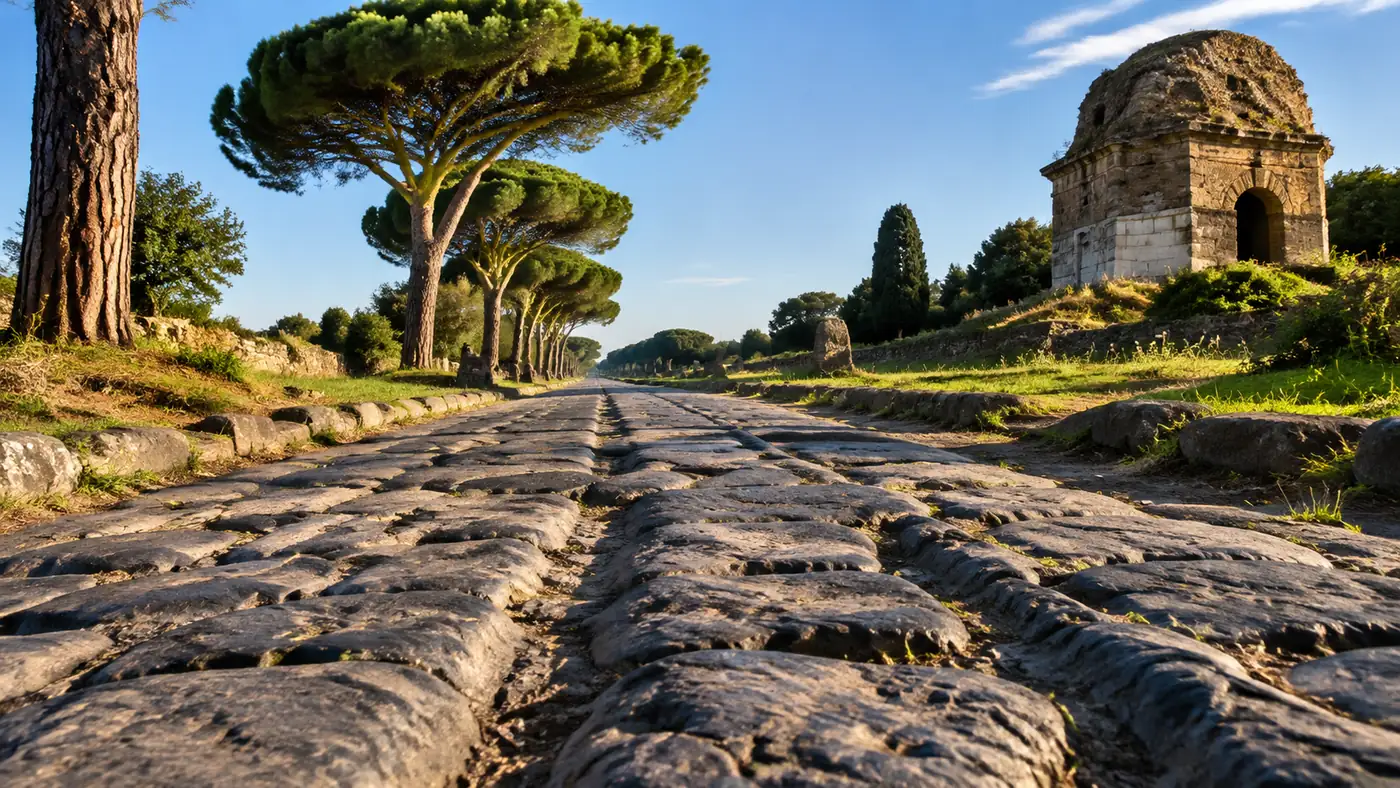
The half of the trip most people skip
Here is the positive case for spending more, and it has nothing to do with the guiding. San Callisto sits between Domine Quo Vadis and the Basilica of San Sebastiano, inside the Appia Antica Regional Park: 4,580 hectares, established in 1988, free and always open, holding over 16 km of the ancient road, UNESCO-listed since 2024. San Sebastiano is about ten minutes’ walk, Domitilla about nine, and a private San Callisto road links the first two on foot and by bike through a gate that keeps catacomb hours.
Private cars have long been barred from the Appia on Sundays and public holidays, and from 19 September 2026 a camera-enforced zone extends that to Saturdays too, 07:00 to 19:00 every weekend except August. The road is at its best exactly when most visitors are free to use it. Bus in and bus out and you see a gate, a staircase and a bus stop; take the e-bike tour or the Appian Way half-day and you see the thing the catacomb was dug beside. A tour that only drives you out and back is buying you a taxi.
Ready to book?
The cheapest way in is the entry ticket, which is the same 40 minutes underground as everything else on this site. If you would rather not work out Roman buses, the transfer tours solve that; if you want the road as well as the catacomb, the Appian Way half-days are the ones I would book. All six carry free cancellation up to 24 hours before the start.
Frequently asked questions
Can you visit the Catacombs of San Callisto without a guide?
No. The catacombs’ own rules state that all tours are guided by authorized personnel, that the minimum group is two people, and that no one may visit alone, leave their group or pass the gates that bound the public route. The guiding is included in the ticket price in Italian, English, French, Spanish and German. See what the visit is actually like.
Are there bones at the Catacombs of San Callisto?
No. The burial niches are open and empty. The relics of the martyrs and popes were moved into churches inside the city in the 8th and 9th centuries, and Saint Cecilia’s went to Trastevere in 821. If bones are what you came for, the Capuchin Crypt in the centre of Rome is the honest answer — the full explanation is here.
Which day is the worst day to plan this?
Wednesday. San Callisto is closed every Wednesday, and tours sold as “the Roman catacombs” still run that day — they go to the Catacombs of Domitilla instead. If you specifically want the Crypt of the Popes, check which catacomb your tour names before you book.