What to expect at the Catacombs of San Callisto
Ready to go underground?Every tour here ends up on the same staff-led walk. Pick the one whose journey you want.
Compare the sixBefore you arrive: hours, booking and the Wednesday
San Callisto opens Monday, Tuesday, Thursday, Friday, Saturday and Sunday, from 09:00 to 12:00 and from 14:00 to 17:00. It is closed every Wednesday, and on 1 January, Easter Sunday and 25 December. The last tours leave at 12:00 and at 17:00, and the ticket office shuts at 16:50. There is also an annual maintenance closure of roughly a month in winter, usually mid-January to mid-February, with the exact dates announced each year; the official hours page has not been updated since 2025, so check it rather than trusting any date you read anywhere, including here.
The custodians’ homepage says online reservations are required. Their tickets page still describes paying at the ticket office. I would treat that as: book ahead, because a walk-up is not guaranteed. Admission is €10 at the door and €12 booked online through Opera Romana Pellegrinaggi, the only officially authorised seller, with reduced rates of €7 and €9 for ages 7 to 16, school groups, students of archaeology, architecture, art history or cultural studies up to 25 with proof, and clergy, religious and seminarians. Under sevens go free. Those tickets are non-refundable, and the Roma Pass and Omnia Card do not cover the catacombs. The cost page sets the whole ladder out.
The gate and the courtyard
The address is Via Appia Antica 110, and GetYourGuide writes the meeting point as 110/126, which is the same gate. You arrive into a green courtyard rather than straight into a hole in the ground. Above you, at the surface, are two three-apsed basilicas known as the Trichorae; one of them probably holds Pope Zephyrinus, who put the deacon Callixtus in charge of the cemetery in the first place, and the boy martyr St Tarcisius. Nobody hurries you through this part, and it is worth ten minutes before your group is called.
Being sorted into a language group
Italian, English, French, Spanish and German are all included in the ticket price, and the custodians say other languages may be offered on request depending on availability. Groups leave every thirty minutes and the minimum group is two people, so you will not go down alone even if you arrive alone. The staff are flexible about this in practice: Kethilyn, who visited on 18 August 2026, had booked in Italian and wrote that they were “super friendly and changed it to Spanish”.
Everyone underground is on the same footing. The guiding is done by the catacombs’ own staff, not by whoever sold you the ticket, so the person who paid from €14 at the time of writing and the person who paid from €79 get the same forty minutes. A guide called Geoffroy — reviewers also spell it Geoffroi and Jouffroy — is thanked in reviews of three different listings, because he works for the catacombs.
The fifty steps
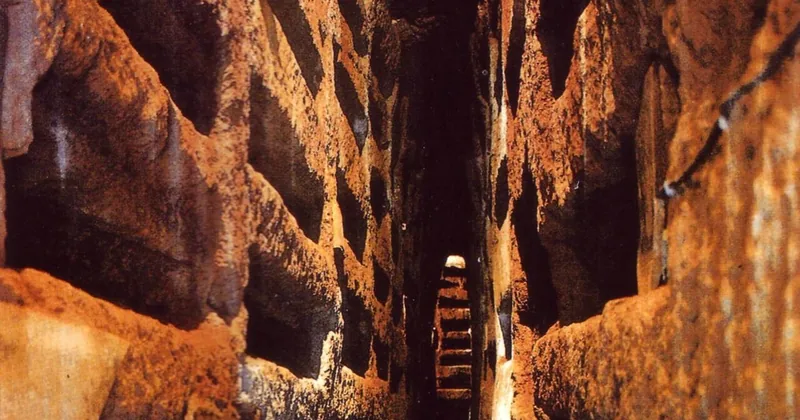
Fifty irregular steps take you down, and fifty bring you back up. There is no lift, there is nowhere to sit at any point on the route, and wheelchairs are not permitted because of the architectural barriers. The custodians also say plainly that they do not recommend the visit to anyone who suffers from claustrophobia. I would take that at face value rather than assuming it is boilerplate. If any of that rules you out, I have written honestly about who should skip it on the worth-visiting page.
The galleries
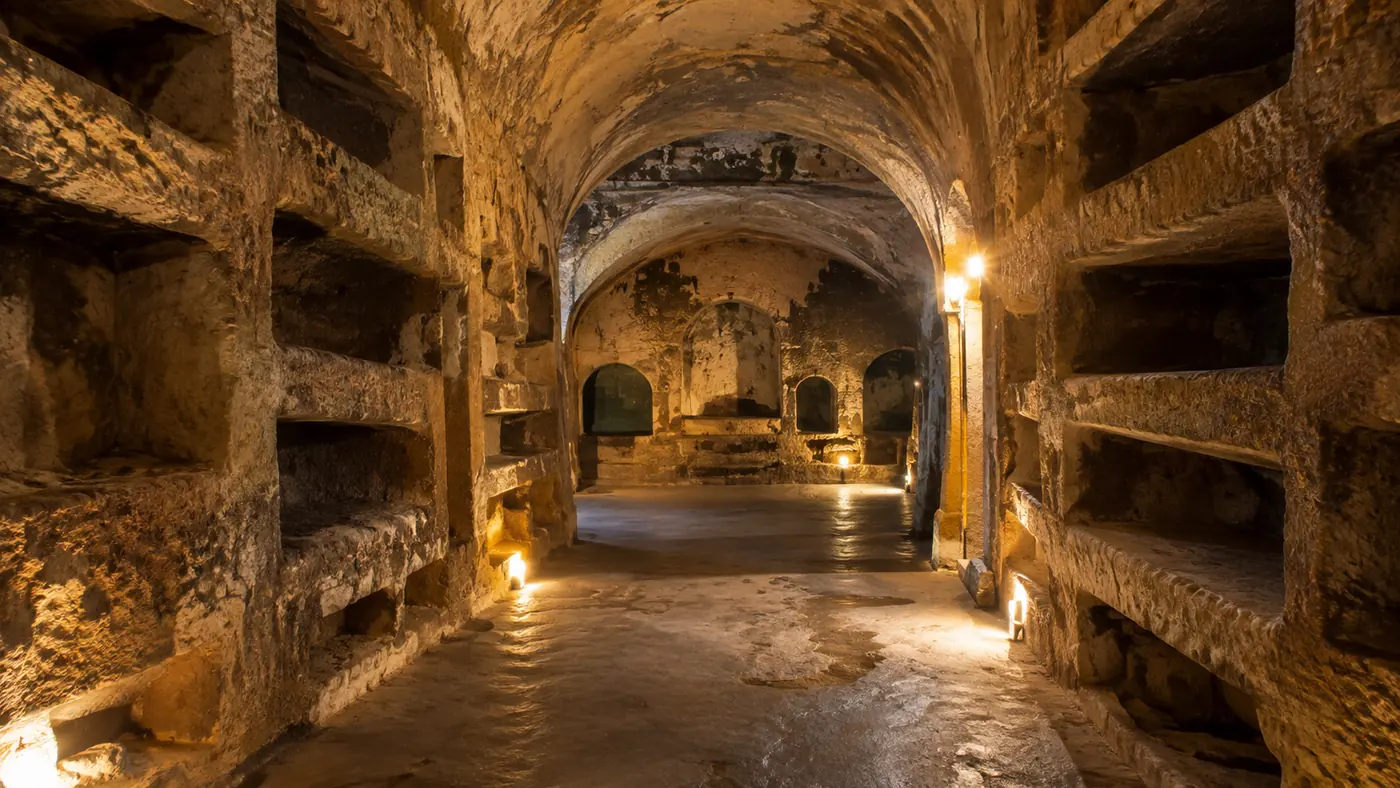
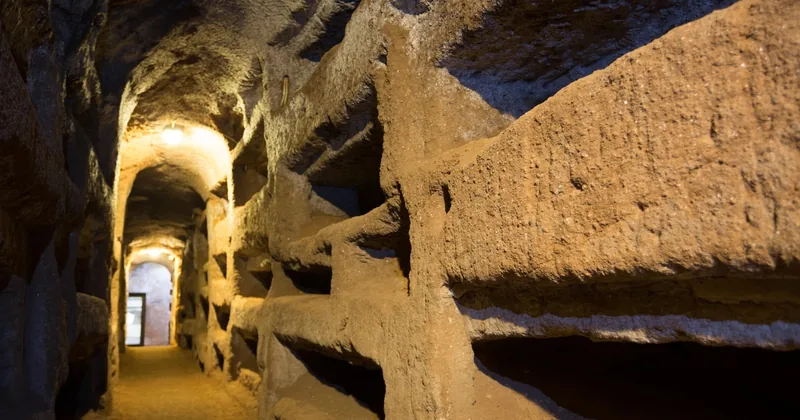
What you walk through are narrow corridors cut into soft volcanic tufo, with rectangular niches stacked in the walls on both sides. Those are loculi, and they are open and empty. The marble slabs that sealed them are largely gone, and so are the people: the popes ordered the relics of the martyrs and saints moved to city churches towards the end of the eighth century and the beginning of the ninth, for security, after the catacombs had been sacked. This surprises a great many visitors, and it should not be a surprise you get at the bottom of a staircase. The full explanation is here.
The complex runs to around 20 km of galleries by the custodians’ reckoning, more than 20 metres deep, on several levels reaching five in places. You will see a small fraction of it. Gates mark the paths open to the public, and the rules forbid going past them.
The Crypt of the Popes
The chamber the custodians call the little Vatican, rediscovered by Giovanni Battista de Rossi in 1854. Nine popes were buried here along with probably eight dignitaries of the third-century Roman church. Five original Greek inscriptions survive on the walls — Pontianus, Antherus, Fabian, Lucius and Eutichian. Four tombstones carry the title bishop and two the Greek abbreviation MPT, for martyr. Pope Sixtus II, killed under the emperor Valerian, was laid in the front wall, and a marble slab reassembled by de Rossi carries a poem written by Pope Damasus, who was pope from 366 to 384.
The Crypt of St Cecilia
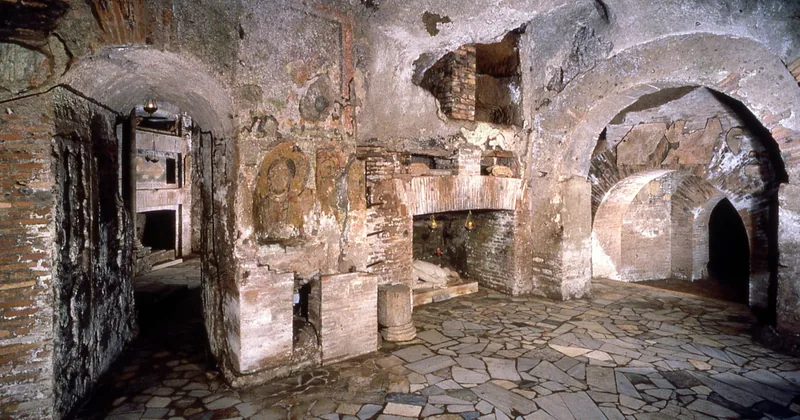
Cecilia was venerated in this spot for at least five centuries, and her relics went to Trastevere in 821. What stands in the niche now is a copy of the statue Stefano Maderno carved in 1599. Reviewers who have been paying attention say so themselves — Lisa, who visited in June 2023, wrote that seeing “the tomb (replica) of St. Cecilia was quite moving”, and the word in her brackets is the correct one. The walls around it carry early-ninth-century paintings: Cecilia at prayer, a niche with Christ holding a Gospel, St Urban, and three martyrs — Polycamus, Sebastian and Quirinus.
The Cubicles of the Sacraments
Five small family chambers frescoed at the beginning of the third century with images of Baptism and the Eucharist, and with Jonah as a resurrection symbol. These are the paintings people remember afterwards. Elsewhere in the complex, in the Crypt of Lucina, Pope Cornelius lies under his own CORNELIVS MARTYR inscription and some of the oldest frescoes in the Roman catacombs survive nearby — a Good Shepherd, and two fish carrying a basket of loaves — dated late second to early third century.
Back up, and what it actually feels like
It is about 16°C down there with high humidity, which is a relief in August and a shock in March. Two of the listings sold here put it at approximately 15°C; the the catacombs’ own rules say about 16, and that is the number I use. Mency, who visited on 5 September 2026, wrote: “i did not expect that the catacombs would be really cold. Even though it was one of the shortest tour I ever had, I was able to grasp the information easily.” Both halves of that are fair. Bring a layer — more on that on what to wear.
What the visit includes
- A staff-led tour in Italian, English, French, Spanish or German
- Departures every 30 minutes through the morning and afternoon
- The Crypt of the Popes, the Crypt of St Cecilia and the Cubicles of the Sacraments
- About 40 minutes underground, which is the custodians’ own figure
What it does not
- Photographs of any kind — staff may expel offenders
- Seats, lifts, wheelchair access, strollers and bulky items
- Smoking, food, drink, pets and touching anything
- Bones, skulls or anything in the niches
Forty minutes, thirty minutes, or an hour
The listings disagree with each other and with the catacombs. The entry ticket advertises 30 minutes. The small-group listing advertises 1 hour, and Alex, who gave it four stars on 8 September 2026, wrote that “it is advertised as 1 hour but the tour itself was about 35 minutes”; he also noted that most of the group had radios and he was not given one. The custodians call the standard visit about 40 minutes, so that is the figure I plan around and the one I would suggest you plan around too. The honest reading is that all three listings describe the same walk. The review pages go through what each one actually delivers.
Getting yourself to the gate
There is no metro station near the catacombs, so every route involves a bus. Metro B to Circo Massimo and then bus 118 puts you about two minutes from the gate, and it is a perfectly good way to do this. If you would rather not work that out, the transfer tours exist and I have weighed them up on the getting-there page.
 Most booked
Rome: Catacombs of St. Callixtus Entry Ticket & Guided Tour
 Best rated
Underground Rome: San Callisto Catacombs Guided Experience
 Transfer included
Rome: Catacombs Guided Tour with Transfer & Capuchin Option
Frequently asked questions
How long does the San Callisto catacombs tour take?
About 40 minutes underground, which is the figure in the catacombs’ own rules. The GetYourGuide entry ticket advertises 30 minutes and the small-group listing advertises an hour; one reviewer timed that one at about 35 minutes. Groups leave every 30 minutes, so allow an hour at the site plus travel from central Rome.
Can you visit the catacombs without a guide?
No. The rules state it three times over: all tours are guided by authorised personnel, the catacombs can only be visited in groups of at least two, and nobody may leave their group or pass the gates that mark the public route. The guiding is included in the entry price in five languages, which is why none of the six tours here guides it.
How cold is it inside the catacombs?
About 16°C with high humidity, year round. Two operator listings say approximately 15°C; the catacombs’ own rules say about 16, so that is the number this site uses. It feels colder than the figure suggests because of the damp, so take a layer — see what to wear.
Are there steps, and is it wheelchair accessible?
Fifty irregular steps down and fifty back up, with no lift and nowhere to sit anywhere on the route. Wheelchairs are not permitted because of the architectural barriers, and the custodians say they do not recommend the visit to anyone with claustrophobia. Who should skip it, honestly.
Can you take photos in the Catacombs of San Callisto?
No. Photography is forbidden and the rules say staff may expel anyone who tries. Food, drink, smoking, pets, strollers and bulky items are out too, and you are asked not to touch anything. If photographs matter to you, the Capuchin Crypt in the city centre does allow them — it is a different kind of place entirely.
Do I need to book in advance?
Book ahead. The custodians’ homepage says online reservations are required while the tickets page still describes paying at the office, so a walk-up is not guaranteed. Official tickets are non-refundable; the GetYourGuide listings all carry free cancellation up to 24 hours before. What each route costs.